


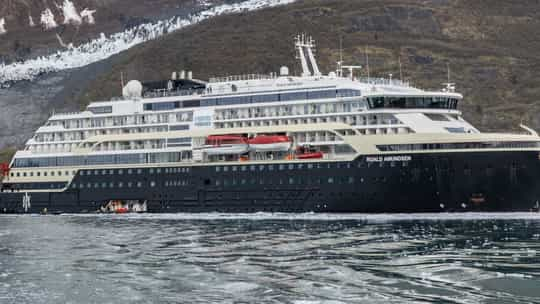
Image courtesy of HX Expeditions ©
Highlights of MS Roald Amundsen
- Ice-strengthened hull - Reaches polar waters and ice-choked channels that conventional cruise ships of this size cannot enter.
- Working science center - Hands-on sessions with the expedition team turn sea days into field study, not downtime.
- Expedition boat landings - Small-boat operations put travelers ashore in places with no port infrastructure at all.
- Daily expert briefings - Recaps and previews from naturalists and historians give every landing real context.
- Forward observation lounge - Panoramic windows deliver glacier and wildlife views in warmth, whatever the weather.
- Norwegian polar heritage - A ship named for Roald Amundsen sailing under the Norwegian flag carries genuine expedition lineage.
- 600-guest scale - Small enough for efficient landings, large enough for multiple dining venues and a full expedition staff.
MS Roald Amundsen Specifications
- Year built
- 2019
- Cabins
- 265
- Crew
- 150
- Guests
- 530-600
- Length
- 140 m (459 ft)
- Beam
- 24 m (79 ft)
- Speed
- 15 kn
- Tonnage
- 20,890 GT
MS Roald Amundsen Itineraries & Sailings
Upcoming sailings on MS Roald Amundsen, earliest departure first.



Why Book With Waterways Cruise?
Four decades of expertise, one dedicated advisor, and every detail handled, from your front door to the gangway and back.
Cruise Concierge
A dedicated advisor who learns your name, your travel style and your preferences, then stays with you from the first conversation to the day you return home. Not a call center. Never a stranger.
100% Custom‑Built
No cookie-cutter packages. Flights, hotels, transfers and shore days are designed from scratch around how you actually like to travel, then refined until the trip feels like yours.
40+ Years in Travel
Founded by J. Richard, a four-decade veteran of the travel industry, and focused solely on premium river and ocean cruising. Decades of ship and itinerary knowledge go into every recommendation.
Book With Total Confidence
A travel agency that is a proud member of Signature Travel Network, CLIA, ASTA and IATA.
Overview of MS Roald Amundsen
The morning starts with a wake-up call about whales, not a bingo schedule. MS Roald Amundsen is an ice-strengthened expedition ship built in 2019, and every design decision on board points the same direction: get 600 travelers close to polar ice, remote coastline, and wildlife that most ships of this size cannot reach. At 20,890 gross tons with a crew of 150, she is purpose-built by Montex Shipyard in Gdansk, Poland, and Kleven Shipyard in Ulsteinvik, Norway, and she sails under the Norwegian flag for HX Expeditions. Named for the first man to reach the South Pole and transit the Northwest Passage, the ship takes that legacy seriously. Days are structured around landings, small-boat excursions, and lectures, not pool decks and production shows. If a traditional cruise is a floating resort that visits ports, this is the inverse: a working expedition base that happens to be very comfortable.Fellow Guests on board MS Roald Amundsen
Expect fellow travelers who pack binoculars before evening wear. The passenger mix on HX Expeditions skews toward curious, well-traveled adults - couples and solo travelers in their 40s through 70s, many of them repeat expedition cruisers, photographers, birders, and people crossing Antarctica or the Arctic off a long-held list. There is no dress-up pressure; the closest thing to a formal night is a clean fleece at dinner. The pace is active but self-directed. Excursion mornings start early, afternoons fill with landings or cruising past ice, and evenings wind down with recaps and briefings rather than nightlife. English is the working language on board, and HX Expeditions historically draws a strong Scandinavian, German, British, and North American contingent, so briefings and announcements are commonly offered in English and German, with shore excursion language groups arranged to match the manifest. Conversation at dinner runs toward what was seen that day, not where the ship is heading for happy hour.
Cabins & Suites
Cabins are designed as warm, functional base camps, and most include an outside view - a meaningful feature when the scenery outside is the entire point of the trip. Staterooms follow a clean Scandinavian design language: light wood, muted tones, practical storage for expedition gear, and bathrooms built to a modern standard rather than a dated cruise-ship one. Suites step up with more space, separate seating areas, and in the top categories private balconies, which on a polar itinerary means a front-row seat to icebergs and wildlife without leaving the room. As with any 600-guest expedition vessel, cabin size is efficient rather than sprawling, but the ship's public spaces - the observation lounge, open decks, and science center - do the heavy lifting. Book an outside cabin at minimum, book early for the polar high season, and treat a balcony as a genuine upgrade rather than a luxury tick-box on itineraries this scenery-dense.
Entertainment & Activities
Entertainment here is the destination itself, supported by a structured program rather than a stage. The expedition team - scientists, historians, naturalists, and polar guides - runs daily lectures and workshops tied directly to the itinerary, covering glaciology, wildlife behavior, polar history, and photography technique. The ship carries a science and education center where travelers can work with microscopes and real samples under staff guidance, turning sea days into something closer to a field course than a day at leisure. Off the ship, the activity menu depends on the region: small expedition boat landings, guided hikes ashore, kayaking among ice, and wildlife watching from deck. Evenings center on the daily recap, where the team reviews what was spotted and previews the next day's landing plan. There is no casino, no theatre, no waterslide - an expedition ship of this class simply does not carry them, and no one on this passenger list misses them.
Dining & Bars
Dining follows expedition rhythms: flexible breakfast and lunch before and between landings, and a relaxed dinner after the day's excursions wrap. In line with the HX Expeditions format, meals are served across multiple venues ranging from a main restaurant with full sit-down service to a more casual option for quick refueling between activities, with cuisine leaning on Nordic and international preparations and an emphasis on sustainable sourcing. Portions and menus are built for people who have been hiking on a glacier all morning. The lounge and bar scene is correspondingly low-key - an observation lounge with forward-facing windows is the natural gathering point, where a drink comes with a view of pack ice or a glacier front rather than a cocktail show. Bar service stays social rather than loud, and room service suits those who want an early night before a 6 a.m. landing call. Dietary requirements are handled with advance notice, as on any well-run small-ship operation.
Wellness, Kids & Venues
Wellness on an expedition ship means recovery, not resort pampering. MS Roald Amundsen carries the facilities typical of a modern vessel of her class: a fitness room with cardio and strength equipment positioned for ocean views, a sauna for thawing out after cold-weather landings, and outdoor deck space designed for watching scenery rather than sunbathing. The real spa treatment is standing on an open deck at midnight under polar light, and the ship's generous observation areas - indoor and out - are built for exactly that. A panoramic observation lounge, expansive open decks, and the science center function as the signature venues on board. On the family question: HX Expeditions permits younger travelers on some itineraries, but there is no kids club and no children's programming, and the rhythm of early landings and long hikes suits teenagers with a genuine interest in nature far better than small children. Most sailings are effectively adult in character.